5 Enterprise AI Agent Use Cases to Transform Your Knowledge

5 Enterprise AI Agent Use Cases to Transform Your Knowledge
An enterprise AI agent is software that reasons and acts to execute multi-step workflows on your business data without constant supervision. Its value lies not in dialogue, but in execution: updating a CRM, following up with a supplier, structuring an expert's knowledge before their departure. Platforms like Skillsay illustrate this shift by turning hours of interviews into a searchable knowledge base, with gains measured in hours saved every week.
In brief:
- AI agents automatically plan and execute tasks across business systems with persistent memory, unlike chatbots that merely respond on a one-off basis.
- An agent's performance depends on its latency, cost per execution, and data quality—aspects that are crucial for effective adoption.
- Their integration relies on a solid architecture with rigorous governance, including traceability, continuous monitoring, and data access management.
- Success lies in defining a narrow scope and regularly measuring key indicators, avoiding relying on immediate full autonomy.
- Capturing knowledge through voice agents and structuring documents are essential to building reliable agents and enhancing the company's collective asset.
Table of Contents
- What is an AI agent and how does it differ from a chatbot?
- How does an AI agent work inside your information system?
- Which AI agent use cases bring the most value by business function?
- How do you integrate an AI agent into an existing information system?
- What governance obligations apply to AI agents in enterprises?
- How do you measure the return on investment of an enterprise AI agent?
- How Skillsay industrializes knowledge capture with AI agents
- Pragmatic checklist to launch an AI agent pilot without making mistakes
- Skillsay, the solution to transform your knowledge into a searchable asset
- Sources
What is an AI agent and how does it differ from a chatbot?
An AI agent is distinguished by three capabilities that a traditional chatbot lacks: it reasons over multiple steps, maintains persistent memory across interactions, and can trigger real actions within your business tools. A chatbot answers a question asked in the moment. An agent receives a goal, plans the steps to achieve it, executes concrete actions, and then checks the result before moving on to the next step.
In practice, this means an agent can query an API to retrieve inventory data, update a customer profile in a CRM, send a personalized follow-up email, or generate a structured meeting summary. These are actions, not just answers.
Three terms consistently come up in this field and deserve clarification. The LLM (large language model) is the agent's reasoning engine, interpreting requests and formulating a plan. RAG (retrieval-augmented generation) allows the agent to retrieve precise information from your internal documents rather than relying solely on generic training data, which drastically reduces factual errors. Finally, the orchestrator coordinates the various tools the agent can use, much like a project manager assigning tasks among specialists.
Here is how to position the three frequently confused tool families:
- Chatbot: Answers one-off questions, holds no memory between sessions, and lacks action capabilities on your systems.
- AI Assistant: Maintains conversation context and can suggest actions, but leaves human users to validate and execute.
- AI Agent: Plans, acts directly on connected tools (CRM, messaging, document databases), and reports on the final outcome.
This distinction matters because it changes the nature of the project. Deploying a chatbot is an interface project. Deploying an agent is an automation project, complete with all that entails regarding system integration, access permissions, and error control.
How does an AI agent work inside your information system?
An AI agent's processing pipeline follows a five-step logic: perception, reasoning, planning, action, verification. The agent first perceives a request or a trigger (an incoming email, a inventory alert, an employee's query). It then reasons about the goal to achieve, builds an execution plan, acts via available connectors, and verifies that the output matches the initial goal before closing the task or escalating an exception to a human operator.
This loop relies on four technical components that must operate seamlessly together:
- The language model, which interprets intent and formulates reasoning.
- The orchestrator, which sequences calls to different tools and handles partial failures.
- Connectors, which link the agent to your operational systems: CRM, ERP, messaging, document repositories.
- Memory and RAG foundation, which grant the agent access to your proprietary business data instead of generic knowledge.
Three operational constraints dictate whether an agent delivers on its promises in production. First, latency: an agent taking thirty seconds to answer a simple question will not be adopted, regardless of output quality. Second, cost per execution: every language model call has a price, and a poorly designed agent that makes unnecessary round-trips can explode a monthly invoice. Finally, data quality: an agent connected to a poorly structured or outdated knowledge base will produce false answers with the same confidence as correct ones—arguably the most understated risk for teams getting started.
Pro Tip: Before deploying, measure your target autonomy rate—that is, the proportion of tasks the agent should resolve without human intervention. Aiming for 100% from day one is a mistake: an autonomy rate of 60% to 70% with clean escalation to a human is far better than an agent hallucinating an answer to avoid admitting it doesn't know.
The OECD report on artificial intelligence adoption by firms corroborates this observation: organizations succeeding in deployment are those investing upfront in data governance and upskilling, not just in the technology itself.
Which AI agent use cases bring the most value by business function?
The most tangible gains occur when an AI agent is assigned a specific, repetitive, and well-bounded task rather than a vague scope. Here are five domains where AI-driven automation currently yields the most measurable results.
- Customer Support: An agent qualifies incoming requests, suggests responses sourced from the knowledge base, and escalates to a human agent only for out-of-scope cases. Teams industrializing this use case report a marked reduction in average handling time per ticket, turning the escalation rate into the primary metric to monitor rather than total ticket volume.
- Sales Operations: The agent qualifies incoming leads, automatically enriches CRM records from email exchanges, and prepares initial draft commercial proposals based on expressed requirements. Sales representatives retain control over negotiations while saving substantial prep time.
- Human Resources and Knowledge Management: Here, the challenge of structuring tacit knowledge becomes paramount. An agent can interview a departing employee, structure their answers, and populate a searchable database for new hires. Onboarding is transformed: instead of relying on a mentor's availability, new recruits query a knowledge base built directly from predecessors' real-world experience.
- Supply Chain and Operations: The agent monitors stock or delivery threshold alerts, triggers notifications, proposes rescheduling in case of shortages, and generates automated operational reports. The main benefit is compressing the time between defect detection and escalation.
- Quality and Compliance: An agent can cross-reference procedural documents with incident reports to flag discrepancies—a tedious, time-consuming task for quality departments already overburdened with daily audits and non-conformance management.
Each use case requires distinct evaluation metrics—a common pitfall is applying the same benchmark to a customer support agent and a supply chain agent. The former is judged on escalation rates and customer satisfaction; the latter on detection latency and successful rescheduling rates. Confusing these metrics leads to misinformed budget allocations.
How do you integrate an AI agent into an existing information system?
A successful AI agent project follows four distinct phases; skipping any single one is the most frequent cause of production failures. Scoping comes first: defining the task boundaries, system integrations, and explicitly stating what the agent cannot execute autonomously. Next comes the prototype (POC), restricted to a single use case and small volume, validating core mechanics before further investment. Industrialization expands the scope, adds remaining connectors, and establishes monitoring. Finally, the Run phase installs a continuous iteration loop—an agent that is never recalibrated degrades when exposed to evolving real-world data.
Target architectures must satisfy four non-negotiable requirements:
- Data Isolation: Information belonging to one customer or department must never leak to another scope, especially in multi-tenant architectures shared across entities.
- Robust RAG Pipelines: Document indexing quality directly dictates agent response reliability—far more than the raw intelligence of the language model selected.
- Continuous Monitoring: Every execution must be logged with its output, cost, and execution duration to catch drift before it becomes an incident.
- Feedback Loops: Failed cases must route to a team capable of correcting agent behavior, rather than being quietly ignored.
A European report on enterprise AI deployment emphasizes that instrumentation and feedback loops determine long-term return on investment far more than initial system sophistication.
Regarding internal talent, projects typically require a pair: one person understanding the business processes and another handling technical integrations. Companies assigning such projects solely to IT departments without business owner involvement often build technically sound agents that go unused in daily operations.
Essential production metrics include actual autonomy rates (share of tasks resolved without human intervention), average cost per execution, processing time, and downstream error detection rates. Without this metric foundation, justifying scope expansion to executive leadership becomes impossible.
What governance obligations apply to AI agents in enterprises?
Human oversight is not an optional feature; it is a structural requirement that must be designed into project scoping from day one. Every agent must have a defined autonomy tier per task, paired with a clear escalation workflow for ambiguous cases. An agent independently sending sensitive client communications without prior validation presents operational and reputational risks that few management teams adequately anticipate.
European regulatory frameworks now establish concrete standards. The European Artificial Intelligence Act mandates transparency and auditability requirements for high-risk systems, directly covering agents operating autonomously within sensitive business processes. Recent European Parliament analyses highlight the necessity of robust governance frameworks and human supervision for any system capable of making decisions or taking actions without pre-validation.
Decision-makers drafting technical specifications should mandate four minimum controls:
- Full Traceability: Every agent action must produce an auditable trail recording inputs, reasoning steps, and final outputs.
- Decision Logging: Maintain logs of instances where the agent failed or was corrected by a human to refine the system over time.
- Data Hosting & Protection: Verify data storage locations for all inputs processed by the agent, particularly for organizations subject to EU data residency compliance.
- Documented Autonomy Levels: Formally establish in writing which decisions the agent can execute independently and which require human approval.
Additionally, NIST offers reference frameworks for standardizing testing and auditability of AI systems—a valuable benchmark even for companies operating outside the United States, given how widely these principles are referenced across the industry.
The OECD study on enterprise AI adoption notes that organizations with mature AI implementations are also those that formalized internal governance guidelines early on—well before scaling up technical scope.
How do you measure the return on investment of an enterprise AI agent?
Calculating the return on investment for an AI agent involves tracking three metric families in parallel: recovered time, operating costs, and quality of adoption. Recovered time measures hours freed per employee on a designated task once the agent stabilizes. Operating costs combine platform licensing, per-execution model fees, and remaining human oversight labor. Finally, adoption quality is revealed by actual user adoption across teams—often a more telling indicator than any technical metric.
A simple method for estimating ROI over six to twelve months compares total project costs (licensing, integration, training) against cumulative hours recovered, calculated using the average loaded hourly rate of affected employees. While imperfect, this model offers a clear order of magnitude to prioritize competing candidate use cases.
- Track actual autonomy rate, rather than initial target autonomy projections.
- Track team adoption rates week over week, not just initial launch spikes.
- Track cost per execution, which can silently drift upward as query volume scales without optimization.
- Track escalation rate to human operators as a direct indicator of perceived agent reliability.
Pro Tip: Never launch an AI agent without training the teams working alongside it. Most deployment failures stem less from technical flaws than organizational pushback, often rooted in concerns over losing expertise or professional autonomy.
A critical long-term risk to mitigate is internal skill atrophy—where the agent becomes a black box that no one knows how to recalibrate. The safeguard is ensuring an internal team retains full comprehension of the agent's reasoning, rather than depending entirely on external vendors. The OECD productivity impact report confirms that AI-driven productivity gains remain unevenly distributed, heavily favoring organizations with quality integration and governance over those relying solely on tool capability.
How Skillsay industrializes knowledge capture with AI agents
Most AI agent projects fail before they start due to a lack of structured business data to feed them. Skillsay solves this upstream bottleneck: the platform captures tacit know-how via voice agents interviewing employees, then ingests explicit knowledge already existing across company documents, audio files, and videos. Everything is structured in real-time into a searchable system, making it possible to build custom AI agents grounded in dependable institutional knowledge rather than scattered, outdated files.
This end-to-end workflow—from capture to retrieval—delivers measurable results for deployed organizations:
- Significant hours saved per employee weekly through direct knowledge access without asking colleagues or digging through filing systems.
- Drastic reduction in onboarding time for new hires, who instantly access a repository built from their predecessors' actual operational experience.
- Enhanced business valuation, as captured enterprise memory turns intangible capital into a concrete asset during mergers, acquisitions, or exits.
These gains apply directly to key operational scenarios: streamlined offboarding capturing departing expert knowledge, accelerated onboarding via searchable databases active from day one, or internal FAQs automatically updated through meeting summaries rather than manual documentation. To explore how this process works from end to end, visit the How Skillsay Works page.
Pragmatic checklist to launch an AI agent pilot without making mistakes
A successful pilot starts with a narrow scope: one task, one department, one measurable volume. Here is the sequence that minimizes false starts: choose a highly repetitive use case, map available data before picking a tool, set a realistic target autonomy rate, implement human escalation from day one, track three core metrics immediately, and re-evaluate at four weeks before expanding scope.
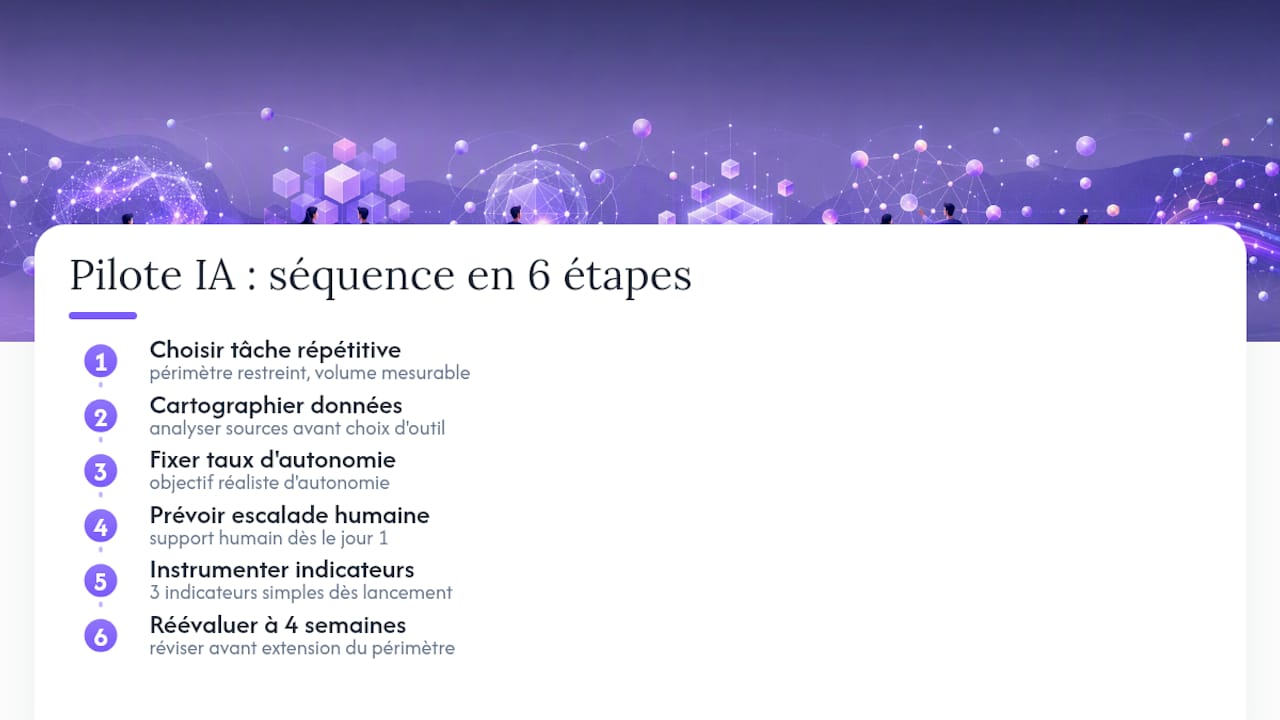
The most common error is counter-intuitive: companies spend months picking technology and only days preparing their data. This is the exact opposite of best practices. An AI agent connected to an unorganized knowledge base outputs false answers with complete confidence, and misplaced trust often costs more than no automation at all.
In the short term, always favor immediate value on a narrow domain over ill-defined enterprise-wide ambitions. Industrialization naturally follows once team trust is established around an initial tangible win.
— quentin
Skillsay, the solution to transform your knowledge into a searchable asset
Where many automation projects stall because business data remains scattered across outdated documents and employee memory, Skillsay fixes the issue at the root—capturing tacit knowledge straight from the source without manual writing friction, long before deploying AI agents.
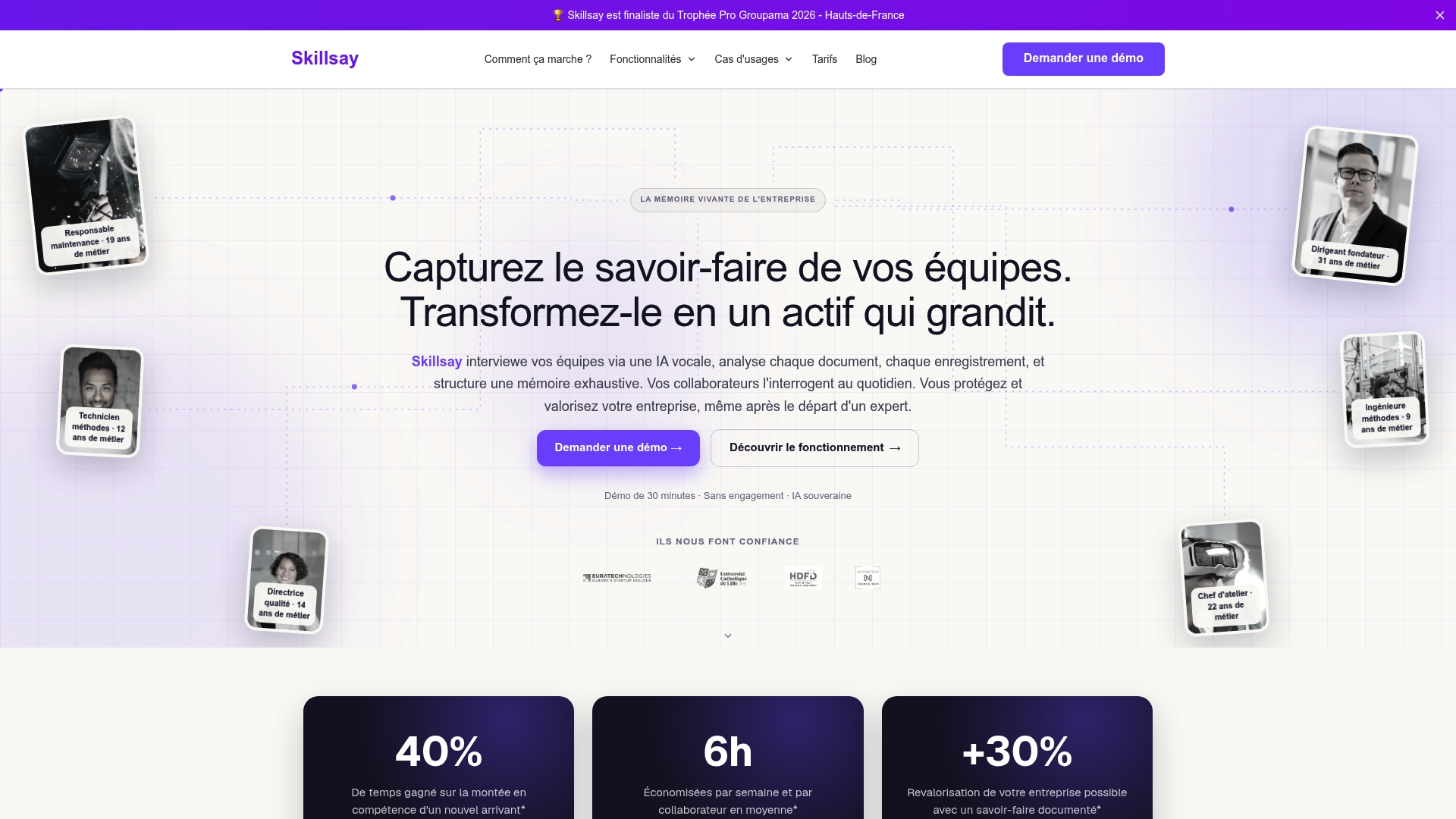
In practice, the platform conducts interviews via voice agents, ingests existing documents, audio, and video, and automatically structures everything into a searchable knowledge base. This foundation enables custom AI agents that are truly reliable, answering with actual company expertise rather than generic common knowledge. Skillsay shines across three critical corporate moments: securing departing expert knowledge during exit transitions, accelerating new hire onboarding, and preserving corporate memory as a valued asset during M&A transactions.
To evaluate what the platform can do for your specific organization, try the Skillsay Hometest to experience the solution prior to commitment.
Sources
For further reading on regulatory standards and adoption trends, several key references offer comprehensive insight. The complete text of the EU AI Act remains the definitive guide for understanding transparency and auditability obligations applicable to high-risk autonomous systems. The official French government portal Info.gouv.fr provides a clear summary for executives looking for an accessible overview.
For trends on enterprise AI adoption, the Stanford AI Index provides an annual global view, while the OECD report details skill and governance requirements accompanying deployment. Lastly, NIST frameworks offer a solid foundation for building internal testing and auditability protocols.
- Regulation (EU) 2024/1689 (AI Act)
- European Parliament analysis on AI impact (2025)
- NIST plan for AI standards (2019)
Recommendations