Freelancers, consultants, integrators: how to keep the expertise you paid for


It's a paradox that few business leaders face head-on. For six months, a year, or sometimes more, the company pays a consultant, freelancer, or integrator for their expertise. It funds their learning curve on its own systems, its own processes, and its own clients. Then the project ends, and on the final day, that expertise walks out the door with them. Deliverables remain. The know-how does not.
This article explains why the end of a contractor's engagement is a blind spot for most companies, what contractual reversibility actually covers, and how to capture a contractor's expertise before they leave, in just a few hours, without asking them to write a single document.
What you buy and what you keep are not the same thing
When a company hires an external service provider, it buys two things: an output (configured software, an implemented process, a successful migration) and expertise (the reasoning behind choices, discarded options, encountered pitfalls, the fine-tuning that makes it work).
At the end of the contract, the company keeps the output. The expertise, however, never left the contractor's head. Yet it is precisely this expertise that makes the output maintainable, scalable, and fixable. Without it, the company owns a system it doesn't truly understand.
Why contractual reversibility isn't enough
Many service contracts include a reversibility clause: end-of-mission documentation, knowledge transfer, handoff meetings. These clauses are useful, but they have a structural limitation: they cover explicit knowledge, never tacit knowledge.
A well-intentioned contractor documents what they are asked to document: architecture, settings, standard operating procedures. They do not document what no one knows to ask them: why they ruled out a solution that seemed obvious, what strange system behavior forced a specific workaround, which setting must never be changed and why. No one is at fault: this knowledge is invisible, even to the person who holds it. It only surfaces in context, facing a concrete problem, when someone asks the right question.
Three moments when this loss comes at a high cost
- When updating what the contractor built. The internal team hesitates, tests, and steps cautiously through a system whose underlying rationale they don't know. Every update takes longer than it should.
- When an incident occurs six months later. The person who knew how to diagnose it is gone. The company calls the contractor back, if available, and pays again for knowledge it had already funded.
- When a new contractor takes over. They start by rediscovering what their predecessor already knew, and bill for that rediscovery. The company pays twice for the same learning curve.
The question to ask at the end of a project is not "did we receive all the deliverables?", but "what does this person know about our company that no one internally knows?".
How to capture expertise before the final day
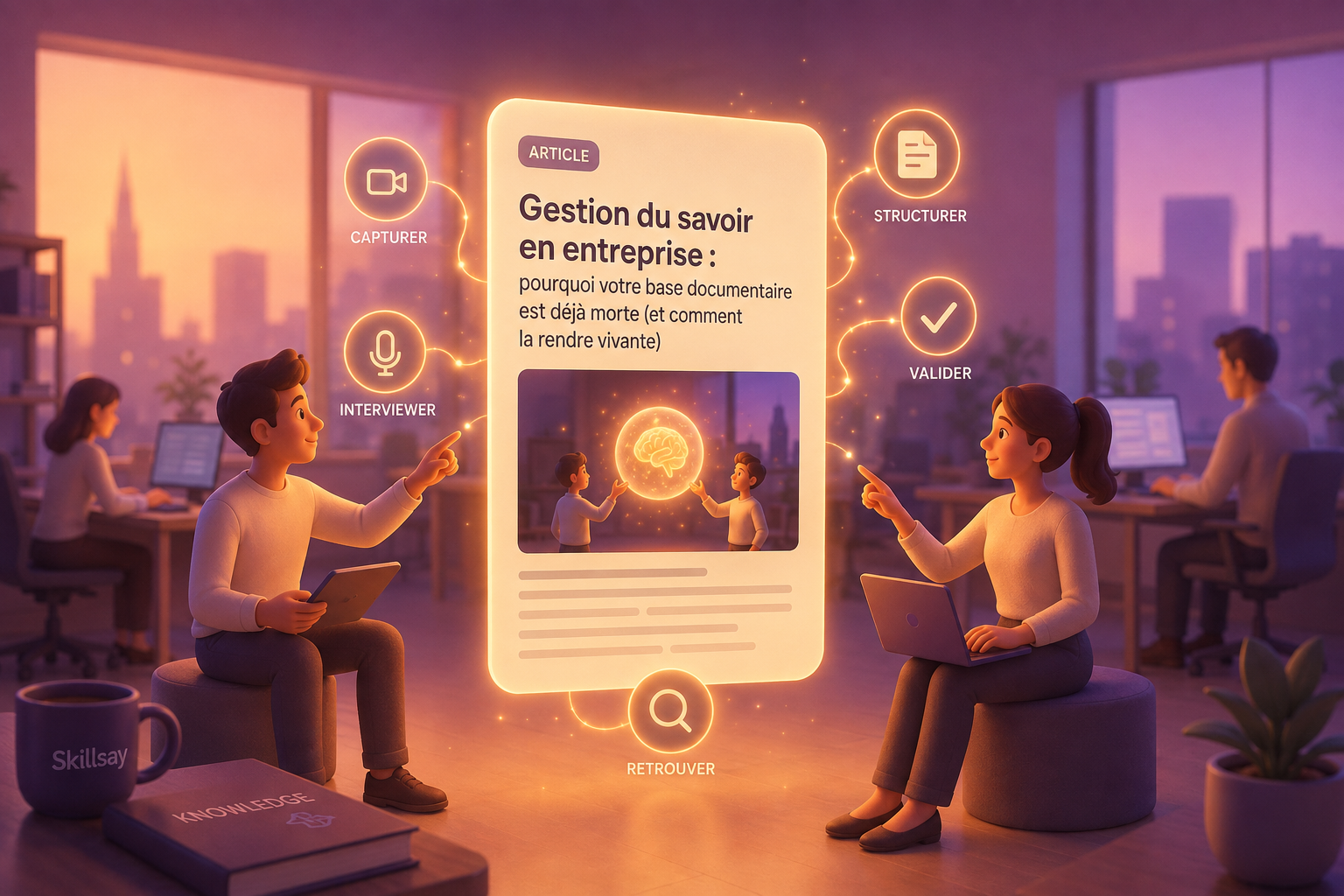
This is exactly what Skillsay enables with Olivia, the AI voice interviewer. The principle: replace the documentation no one has time to write with a conversation everyone has time to have.
In practice, during the final weeks of the project, the contractor conducts a few voice interview sessions with Olivia. She asks questions just as an experienced peer would: adapting to the field, probing the "why" behind the "how", uncovering blind spots, and following up on incidents encountered and choices discarded. The contractor simply speaks—writing nothing—and a few hours are enough to capture the essentials of what only they know, both tacit and explicit.
Each session is transcribed, structured, and fed into the company's knowledge base, alongside deliverables, documents, audio, and video from the project. Afterwards, your internal teams, or the next contractor, can query this base in natural language and get sourced answers in seconds: the consultant's reasoning remains accessible long after their departure.
The most effective approach is to include this knowledge capture in the reversibility clause right from contract signing: a few hours of interviews at the end of the project, planned and billed like any other transfer task. For a project already underway, it's never too late: even two weeks before the end, capturing the topics where the contractor is the sole expert is infinitely better than a generic handoff document.
Questions business leaders ask us
Will the contractor agree?
In the vast majority of cases, yes. For them, it is billable project time with no writing effort required, and it demonstrates professionalism that they can highlight with future clients. Knowledge capture is planned contractually, just like documentation.
Who owns the captured knowledge?
Your company does. The expertise applied to your systems and processes, funded by your company, is captured in your Skillsay workspace, on your data, with your access controls.
What about confidentiality?
Data is encrypted, hosted in France, with access controlled workspace by workspace. The contractor only accesses what pertains to their project, and their interviews stay within your environment.
Key takeaways
An external contractor's expertise is an asset your company has already paid for. Letting it walk away completely on the final day, only to repurchase it during the next incident or engagement, is an avoidable expense. A few hours of voice interviews at the end of the mission are enough to keep this knowledge in-house, searchable by your teams for as long as needed.
Is a project ending soon at your company? Discover our Knowledge Capture offering or request a demo: we will show you concretely how an end-of-mission knowledge capture works.